November settles over Brussels, with the days growing shorter and the trade agenda only getting busier. EU-China relations take a pragmatic turn, as a first set of “shared understandings” on cars and rare earths comes with EU capitals pressing the Commission to sharpen its toolbox. On the legislative front, a Franco-German compromise breathes new life into the Industrial Accelerator Act, raising hopes of a deal before Christmas. Across the Atlantic, the EU and Canada launch an “Alliance for the Future”, concluding a Digital Trade Agreement along the way. Finally, we look ahead to the DiversifyEU package, expected before the end of the year.
EU-China: A deal on wheels, a toolbox in waiting
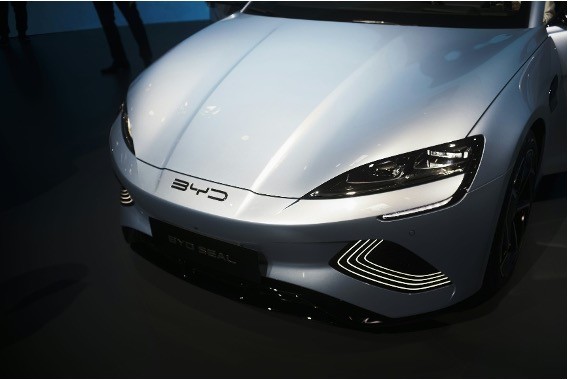
Europe has finally played its strongest card: its market. On 8-9 October in Beijing, Commissioner Šefčovič and Chinese Commerce Minister Wang Wentao sealed 16 “shared understandings”. The Commissioner calls it a “first step”. Against a €360 billion deficit, critics call it a down payment.
Cars take the wheel. From 2027, only 350,000 Chinese-made hybrids a year will enter the EU, rising 6% annually over four years, down from over 800,000 expected this year. The twist: Chinese-brand cars built in Europe will not count. The message to Beijing? Bring capital, not containers. China sweetens the deal with faster rare earth licenses and lower tariffs on car parts, olive oil and even ice cream.
Yet the bill remains small. Think-tank Bruegel argues the car concession barely scratches the imbalance, and rare earth supply still depends on Beijing’s goodwill. China, meanwhile, secured a dialogue on the Foreign Subsidies Regulation and keeps its eyes on EU controls over chip-making machines.
In the meantime, EU capitals are not waiting. Merz and Macron want a faster instrument to shut the single-market door, and EU leaders have asked the Commission to urgently “enhance the EU toolbox”.
Next stops: a ministerial call in January and consultations in March, with raw materials top of the list. Brussels will talk with one hand and stock its arsenal with the other. Businesses should watch both.
Zoom in:
On 27-29 October, a delegation of the European Parliament’s INTA Committee visited China, led by chair Bernd Lange of the S&D Group. The first such occasion since 2018, Lange and other MEPs met with officials from the Chinese Ministry of Commerce, in what was apparently a successful visit: speaking in an interview with Deutschland Radio on 29 October, Lange noted a “more constructive attitude” from China on the trade imbalance. However, he cautioned that the EU could have to wait until at least March 2027 for a concrete outcome to address the ongoing tensions.
Zoom out:
As Tradeviews discussed in the October edition, China’s trade surplus is a thorny issue that goes right to the heart of the country’s economic and geopolitical strategy. Certainly, it has helped to build the dependency of the rest of the world, including the EU, on cheap Chinese goods. Faced with an aging population and growing debt burden however, high exports also enable China to deleverage by boosting real GDP and generating valuable foreign currency.
Industrial Accelerator Act: The Franco-German engine revs up
Talks over the Industrial Accelerator Act (IAA), the EU’s bid to accelerate industrial investment and decarbonisation with new “Made in Europe” requirements, have taken an unexpected turn.
In the European Parliament, MEPs proved to be very attentive to the IAA draft report, filing an astonishing 5,300 amendments. Among the most eye-catching submissions: a proposal from a trio of German EPP MEPs to kill the bill outright. Unlikely to succeed, certainly, but with support from at least 24 colleagues, enough to illustrate the sheer discord over the IAA.
The real action, however, is over in the Council, with growing buzz around a deal between France and Germany, long at loggerheads: Paris wants strict “Made in Europe” criteria; Berlin a “Made with EU” approach giving reciprocal access to partner countries. Despite this, the pair recently launched a surprising set of joint interventions.
On 5 October, President Macron and Chancellor Merz published one paper calling for agreement on the IAA before the end of 2026, soon followed by another setting out a proposal on the scope of “Made in Europe”. Now, only the EU 27 would be automatically included. The UK and European Economic Area countries could still apply, but for other partners, no such luck. And behind Berlin’s about-turn, a quid-pro-quo on the struggling German automobile industry.
In return for narrow “Made in Europe” rules, France agreed to relax emissions standards for carmakers. The 90% emissions reduction target before 2035 remains, but Volkswagen and co. need no longer compensate for the remaining 10%. Sweetening the bargain: extra compensation credits for every “Made in Europe” electric car sold.
Whether the deal makes it into the final agreement remains to be seen, and Germany’s vehicle lobby itself has also proven somewhat underwhelmed. But a nicely-wrapped IAA under the Christmas tree just became far more likely.
EU-Canada Summit: An alliance for the future, short of membership
From flirtation to vows: the EU and Canada have formalised their rapprochement. At the 21st EU-Canada summit in Montreal on 29-30 October, Presidents Costa and von der Leyen and Prime Minister Mark Carney launched an “Alliance for the Future”, a framework for deeper cooperation on trade, critical raw materials, defence, digital and research.
What did not make the cut is just as telling. “Associate membership” was dropped from the joint statement after previous objections led by Germany. Instead, both sides will define by 2027 “an ever-closer association of Canada to the EU, short of full membership itself”. The label lives on, though: Carney still speaks of Canada “becoming the European Union’s first associate member”, and von der Leyen champions “an association without accession”.
The economic deliverables are concrete. Negotiations were concluded on a Digital Trade Agreement complementing CETA and on a second-generation Competition Agreement, while a treaty framework signed with the European Investment Bank will unlock European investment in Canadian critical minerals.
Yet the green partnership shows cracks. The statement calls the Green Alliance “our compass” but also commits to a feasibility study on liquefied natural gas (LNG) exports to Europe. Meanwhile, Carney has scrapped the consumer carbon price, repealed the EV sales mandate and dropped the cap on oil and gas emissions.
With US tariffs pushing both sides together, the direction is clear. However, the devil is in the details, which will decide whether this alliance delivers on its promises.
What we know about the DiversifyEU instrument

The Commission has long promised to introduce a new flagship instrument to accelerate this new era of post-Fukuyama European trade. Well, the wait may soon be over: the Commission indicated that the before the end of the year, it is whispered around December 9, it will present its DiversifyEU package.
While the details of the package have yet to be unveiled, its aim is to advance the EU’s diversification efforts by strengthening supply chain resilience and reducing dependencies on critical products. As explained in the call for evidence, the Commission intends to give European companies stronger incentives to diversify their supply chains through support measures and demand aggregation.
Moreover, the Commission wants to fast-track the adoption of economic security measures. To counter unfair competition from third countries more effectively, including the sudden imposition of tariffs, the EU is working on a framework to strengthen and streamline the use of its anti-coercion and anti-subsidy tools.
While this initiative is expected to involve adjustment costs for businesses exposed to critical supply chain dependencies in the short term, it promises a net win in terms of economic performance and job creation in the long run. To bridge the gap between short-term economic stress and long-term success, the Commission has pledged to roll out support measures.
As we slowly approach the end of the year, time will tell the extent of the economic sectors covered by the package and whether this new instrument will prove to be a real game changer in EU trade policy. To make sure you don’t lose sight of it, follow us on #Tradeviews!
Over on X…
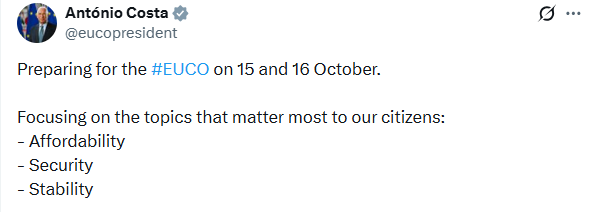
Finally, an EU agenda with an acronym the public can get behind.
On the radar:
5 November | EU–Mercosur Forum 2026: The Parliament Magazine will host the EU–Mercosur Forum in Brussels, with welcoming remarks by INTA chair Bernd Lange and MEP Evelyn Regner. The ambassadors of Argentina, Uruguay, Paraguay and Brazil, together with a representative of ApexBrasil, will discuss how to turn shared ambitions into practical cooperation, from sustainable agriculture and forestry to industrial value chains, raw materials and clean mobility.
30 November | Final CBAM political trilogue on the downstream extension: Parliament and Council negotiators are scheduled to meet for the possibly final political trilogue on the extension of CBAM to downstream products and the new anti-circumvention rules. The first round on 20 October ended without an overall agreement, as the institutions aim to strike a deal before the end of 2026.
What we are reading:
Ambition without precision? Is the Industrial Accelerator Act aiming at too many targets at once? In The EU Industrial Accelerator Act: Strategic Ambitions and Design Challenges, researchers from the Kiel Institute argue that the IAA’s central weakness is a lack of precision rather than a lack of ambition. The article claims that the Act bundles decarbonisation, competitiveness and geopolitical goals under a single framework, with a strategic sector definition that is too broad and local content requirements that are not tied to clear objectives. It also warns that the new FDI conditions may lead Chinese investors to comply only selectively or to reroute investment through third countries. This makes it a useful companion to the Franco-German negotiations on the scope of “Made in Europe”.

Alessandro Pizzi, Public Affairs Consultant