May marks a historic shift as the EU–Mercosur interim trade Agreement finally enters provisional application, giving a breath of fresh air to the EU exporting sectors. In contrast, an on-and-off diplomatic relationship with China leads Brussels to remain assertive and block high-risk vendors from critical solar infrastructure to safeguard economic security. This edition also features a guest article by @Mishel Reali on how the EU–Japan partnership serves as a blueprint for economic security, alongside updates on new digital trade milestones with South Korea and Morocco.
EU-China relations: dialogue returns, tensions remain
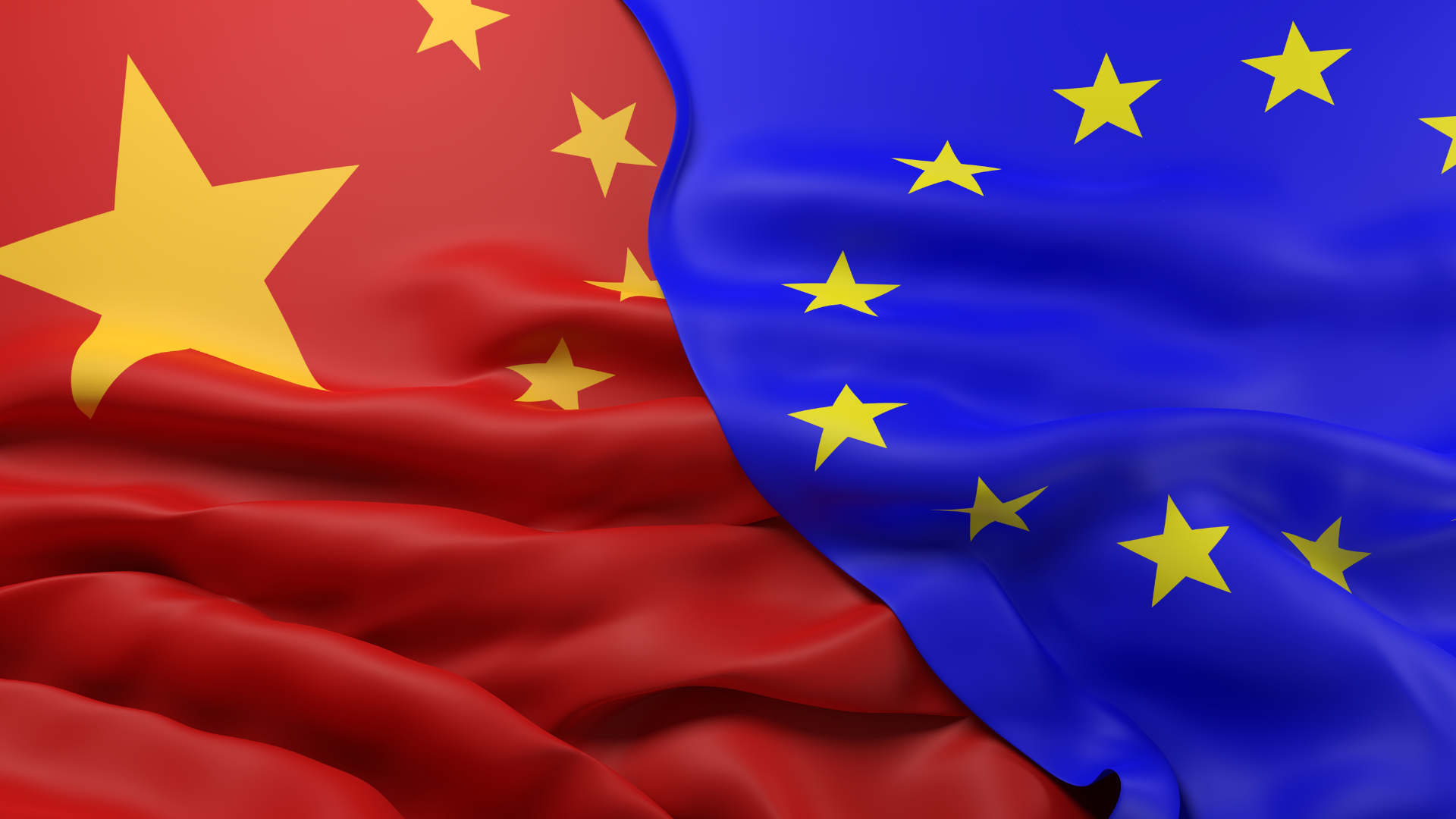
As EU relations with the United States remain uncertain, some voices in Europe are looking east. On April 14, Chinese President Xi Jinping called for closer ties with the EU following talks with Spanish Prime Minister Pedro Sánchez, who has been urging the EU to diversify its partnerships. The meeting took place shortly after a European Parliament delegation visited Beijing for the first time in eight years.
It would be tempting to say that it has been a promising month for EU-China relations. China issued new guidance on platform regulation, which EU officials see as acknowledging European concerns. The European Commission also welcomed China’s decision to withdraw its anti-suit injunction policy on standard essential patents following a WTO ruling.
However, the EU’s approach remains cautious. While Industry Commissioner Stéphane Séjourné has highlighted the importance of foreign investment, including from China, he has also pushed for initiatives such as the Industrial Accelerator Act, which would impose stricter conditions on foreign investors and limit access to public support, particularly for Chinese businesses exporting electric vehicles and solar panels components.
Concerns continue to be raised by European industry. In a recent letter to the Commission, several European chemical producers warned that Chinese producers of titanium dioxide are acquiring assets in the United Kingdom in order to bypass existing anti-dumping duties.
Zoom In: This week, the European Commission confirmed that it will block EU funding for solar panel inverters supplied by high-risk vendors, including Chinese market leader Huawei. The measure is based on national security concerns, as such equipment could be used to interfere with energy systems or access sensitive data, echoing earlier EU action on telecom networks and critical infrastructure. While formally country neutral, covering jurisdictions such as China, Russia, Iran, and North Korea, it signals a broader shift, with solar infrastructure increasingly seen as an issue of economic security.
Zoom out: Eurostat figures illustrate the scale of the challenge, with the EU recording a trade deficit with China of €359.8 billion euros in 2025, largely driven by imports of electrical machinery and electronic equipment.
Our take: While political dialogue is picking up and some technical issues are being addressed, structural tensions remain. The EU is not closing the door to China in principle, but it is unwilling to move towards a more open stance. Engagement will continue, as efforts will be placed on striking the right balance between ensuring fair competition, security, and cheap prices for European consumers.
It’s Mercosur day
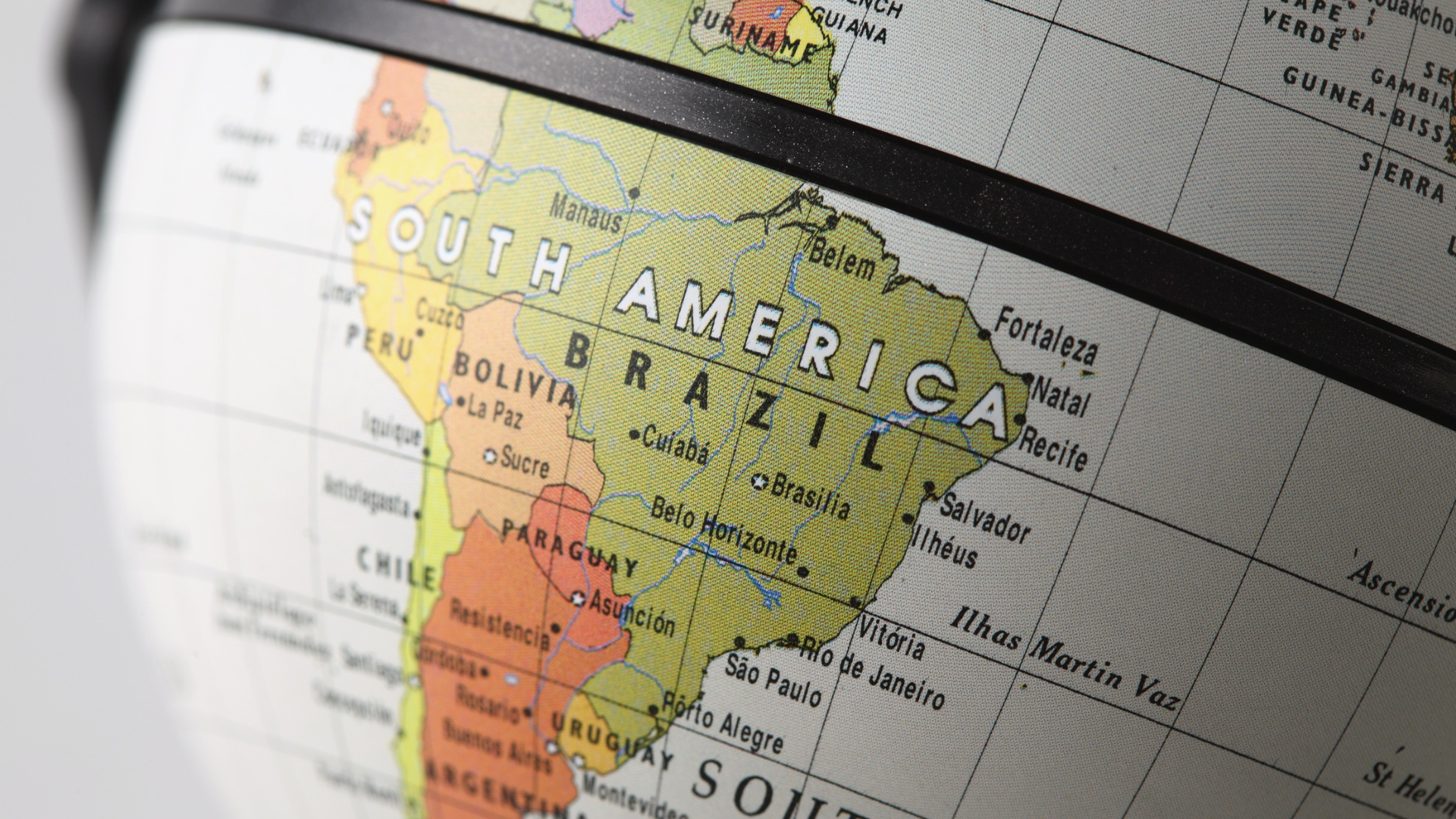
On May 1st, the EU-Mercosur Agreement provisionally entered into force after more than twenty-five years of negotiations.
As a reminder, the deal aims to eliminate tariffs on over 90% of traded goods between the Mercosur countries and the EU, creating relevant regulatory impacts and business opportunities in sectors dealing with vehicles, machinery, wine, chemicals and agricultural products.
Whereas celebrations were quick to follow, the provisional nature of the file’s application still mandates caution seeing as the trade portion (iTA agreement) lacks ratification from Parliament and the political side (EMPA agreement) awaits final ratification from both Parliament and the Council.
Caution is particularly warranted because the case brought by the European Parliament to the CJEU, on the basis that the Commission did not follow treaties’ procedures when provisionally implementing the deal, is still very much open and its outcome uncertain. Moreover, Poland announced it will file a legal challenge against the EU-Mercosur trade deal at the CJEU on the same basis. While this gesture is largely seen as symbolic, it signals a resurgence of anti-Mercosur sentiment that could gain a wider platform when Ireland, a country historically against the deal, assumes the Council Presidency on July 1st.
In the meantime, businesses must adapt their corporate strategies to ensure they reap the benefits of this new framework without losing sight of the partnership’s future development.
Reach out to us to find out exactly how!
The EU–Japan EPA: a blueprint for resilient trade
In 2018, the European Union and Japan signed the Economic Partnership Agreement (EPA), creating one of the world’s largest free trade areas, covering more than 570 million people and accounting for close to 30% of global GDP. At full implementation, the EPA liberalises 99% of tariff lines for the EU side and 97% for Japan. In October 2023, the two sides concluded an agreement to incorporate provisions on the free flow of data.
Since entering into force, the EPA has delivered strong results. According to European Commission data, total trade flows (goods and services combined) grew by 20.4% between 2018 and 2023. EU exports to Japan are led by chemicals, motor vehicles, machinery, optical and medical instruments, and food and drink. Imports run along similar lines with Japanese machinery, vehicles, chemicals and optical equipment dominating the flow into Europe. EU goods exports to Japan which are highly concentrated in the industrial sector (93.3%) reached €68.8 billion in 2024, up 4.5% from €64 billion the previous year. Trade in services increased 34.7% between 2018 and 2023 to €58 billion.
As for investment flows, they are substantial in both directions: Japanese FDI stock in the EU stands at €212.5 billion, while EU investment in Japan amounts to €86.6 billion. Taken as a regional bloc, Europe is the largest source of foreign direct investment in Japan, accounting for over 43.4% of Japan’s total inward FDI stock. Nevertheless, this figure covers the broader European continent rather than the EU alone.
In a world of rising protectionism and fragmenting supply chains, the EU–Japan relationship offers businesses something increasingly scarce: predictability. At the 30th EU–Japan Summit in 2025, both Brussels and Tokyo reaffirmed their commitment to upholding the free and rules-based multilateral trading system, with the WTO at its core, while signalling a shared determination for WTO reform.
A further dimension worth watching is the growing convergence between the EU and the CPTPP, of which Japan is a member.
The 2025 Summit also saw the launch of the Competitiveness Alliance, which marks a formal broadening of the bilateral agenda to encompass supply chain resilience, critical raw materials, and economic security. Japan brings hard-won experience to each. The Economic Security Promotion Act of 2022 introduced mandatory supply chain mapping across fourteen sensitive sectors, from semiconductors to rare earths, and a robust foreign investment screening regime.
Following the steps of Japan, the EU has adopted its own Economic Security Strategy in late 2025. On critical raw materials, Japan has also been leading the way, having built up substantial experience in securing and stockpiling strategic minerals over the past two decades. The EU is now looking to follow suit: under its upcoming RESourceEU Plan, Brussels is considering the creation of a joint critical minerals purchasing and stockpiling centre based on Japan’s Organization for Metals and Energy Security (JOGMEC).
Mishel Reali works at the EU-Japan Centre for Industrial Cooperation, where he contributes to the organisation of business missions. He also serves as assistant in the Business Round Table (BRT) Secretariat.
Please note that the views expressed in this article are the author’s own and do not represent the position of the employer with which the author is affiliated.
EU cranks up the steel deal
The EU is preparing new steel measures that are set to apply from 1 July 2026. After reaching a provisional agreement during late April’s trilogue, the European Parliament voted to adopt the agreed text. On the Council’s side, it is proceeding to formally adopt the Regulation addressing negative effects related to global overcapacity on the EU steel market.
Anticipating civil society’s calls to protect the European steel industry, the EU vocalised that a tightened approach is essential to shield European producers from unfairly priced imports (particularly from Asia) and global overcapacity.
The agreement reached by the Parliament and Council introduces, amongst other things, a new tariff-rate-quota (TRQ) system which lowers import quotas by limiting tariff-free import volumes to 18.3 million tonnes a year (a 47% reduction compared with 2024 steel import quotas). Moreover, the deal raises customs duties from 25% to 50% on steel imports that exceed the agreed quota, as well as on steel imports outside the quota system, and strengthens the traceability requirements for imported steel products. Finally, the agreement envisions a “melt and pour” provision mandating that the country where the steel is melted and poured will be used as one of the decisive factors when allocating quotas to third countries.
These new measures come in parallel with the phasing in of the Carbon Border Adjustment Mechanism, the EU’s environmental policy tool for fair carbon emissions pricing. As such, concerns are being raised about a “double burden” on foreign suppliers. MEPs have been questioning whether combining CBAM charges with traditional tariffs is reasonable or World Trade Organisation (WTO) compliant.
On the other hand, European steel producers rejoiced at the prospect of long-demanded relief from foreign competition, a position that the Commission frames aligned with both climate and industrial goals.
What’s up with digital trade agreements?

The EU is reshaping its external economic relations around digital policy, moving beyond tariff-based trade toward standards, regulatory alignment and compatible technologies as the main drivers of market access and integration. In this context, digital agreements and dialogues have become tools of strategic influence, linking digital trade and technology rules with broader cooperation on economic security, supply chains and critical technologies.
EU-Morrocco Digital Dialogue: On 8 April 2026, the European Commission and Morocco’s Ministry of Digital Transition and Administrative Reform launched the EU–Morocco Digital Dialogue. In practical terms, the initiative establishes a structured framework for cooperation on artificial intelligence, supports digital start-ups, secures digital infrastructure, and ensures the interoperability of public digital systems (including digital wallets). Early operational steps already in play include cooperation between four European supercomputing centres (i.e. BSC, CINECA, GENCI and LUMI) and Morocco’s Mohammed VI Polytechnic University, which hosts Africa’s most powerful supercomputer. While the next steps remain open-ended with no detailed roadmap or specification of an implementation timeline yet, the immediate phase will focus on establishing working-level cooperation across AI, digital infrastructure and public services.
EU-Republic of Korea Trade Committee: On 17 April 2026, Commissioner Maroš Šefčovič and Minister Yeo Han-koo had their first Strategic Dialogue on Trade which ended with the endorsement of the EU-Korea Digital Trade Agreement which will be signed later this year. Regarding trade, the meeting confirmed continued growth in bilateral trade and investment, while addressing outstanding market access issues affecting EU exports, including agricultural products, offshore wind, automotive trade, and restrictions on online alcohol sales.
Over on X…
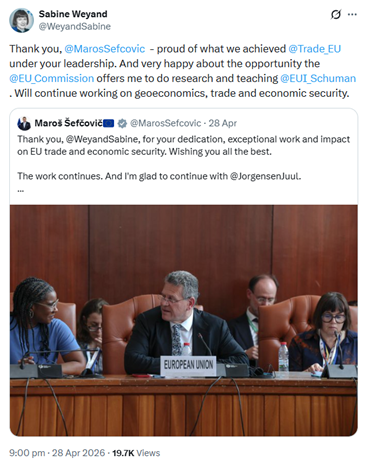
“Siri, play Goodbye My Lover by James Blunt…”
On the radar:
1 May | Launch of EU–Mercosur Provisional Application: Officially beginning this month, the provisional application of the EU–Mercosur Interim Trade Agreement marks the start of tariff reductions for European industrial sectors like automotive and machinery.
13 May | Civil Society dialogue meeting with Sabine Weyand: Interested in global trends and trade forecast while also prone to nostalgia? Join the Commission’s civil society dialogue where not-for-long DG TRADE Director-General, Sabine Weyand, will discuss recent trends in EU trade policy and economic security given the current geopolitical environment, as well as prospects on key current and future initiatives.
What are we reading?
Globalisation rewired: Is the “disastrous decade” of trade, marked by Brexit, Trump-era tariffs, and the closure of the Strait of Hormuz, the final nail in the coffin for the global order? Not according to the former chief economist of the Bank of England. He argues that, while the “golden era” of pure efficiency is dead, we are entering an age of resilience. Much like the financial system’s “reboot” after 2008, global trade is developing the “muscle memory” to reroute and reconfigure crises rather than collapsing under them. With trade remaining a “fiscal–free” way to boost national income and curb inflation, the article suggests that globalisation isn’t being retired, it’s just being rewired for a more volatile century.
The Union’s change of pace: Can trade policy serve as the primary engine for European geopolitical power? According to the study, The Union’s Change of Pace, written by Paolo Guerrieri of the LUISS Research Center for European Analysis and Policy, the EU has shifted from simple market liberalisation to a strategy of “open, sustainable and assertive” trade. By finalising landmark agreements with Mercosur, India, and Australia, Brussels is leveraging its market size to secure critical raw materials and export its regulatory standards. The paper argues that these deals are not merely economic successes but a demonstration of the Union’s capacity to act as a unified global player when institutional procedures allow it to bypass intergovernmental paralysis.

Alessandro Pizzi, Public Affairs Consultant

Sophia Nee, Communications Consultant