A narrow stretch of water off the Persian Gulf is once again under the limelight of global tensions. For Europe, the Strait of Hormuz is not a distant crisis, but a strategic pressure point where energy security, maritime risk, and geopolitical rivalry converge. Already two months in, its impact is already reverberating across the continent, shaping risk, policy, and political choices. The question now is no longer how Europe is affected, but how it responds, and how far that response should go.
Hormuz: beyond energy, a convergence of security risks
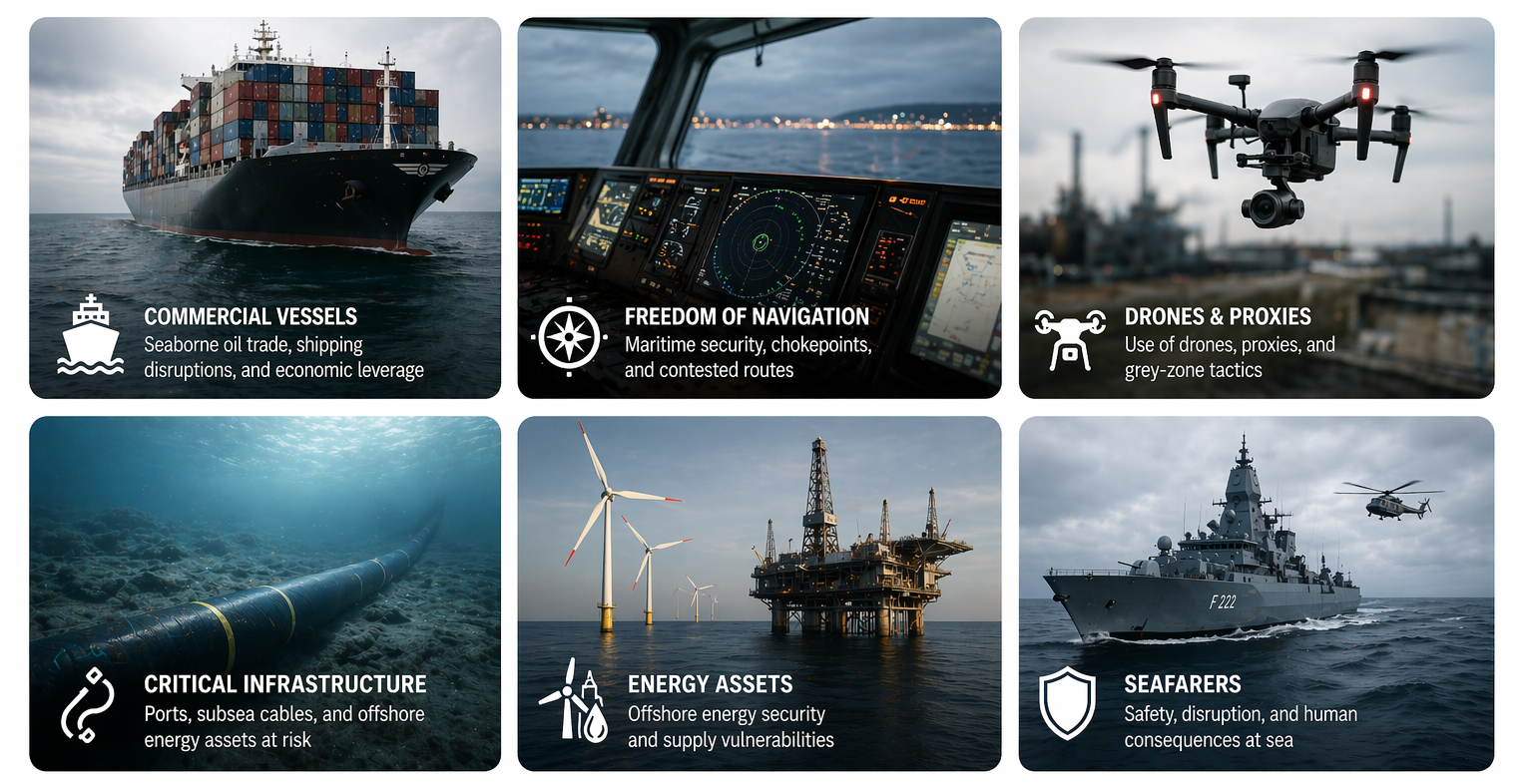
A 17th-century Persian historian once described Hormuz as “the crown jewel, should the world be a golden ring”. True as ever, it is one of the world’s most critical energy arteries, letting roughly 25% of global seaborne oil trade pass through each day. Beyond energy, Hormuz sits at the crux of a myriad of security risks for Europe. Overall, threats to commercial vessels and freedom of navigation expose maritime, economic, and military vulnerabilities while the use of drones, proxies, and other grey-zone tactics enable disruption without having to open conflict. Risks also extend to critical infrastructure, from ports to subsea cables and offshore energy assets, which the EU has already made a point of communicating on as a growing security priority. These dynamics carry direct human consequences, including risks to seafarers and disruptions to essential goods such as food and fertilisers. Finally, perhaps the most incipient risk is the internal security implications for Europe in terms of disunity, efficiency and credibility.
A calibrated response: security without escalation

The EU’s response has been carefully tailored to uphold global security without risking escalation. On 19 March, the European Council unveiled its conclusions condemning the threats to navigation in the Strait. It also called for the reinforcement of ongoing defensive maritime operations such as EUNAVFOR ASPIDES. Extended until February 2027, the EU explicitly decreed that the operation was to remain explicitly defensive, focusing on situational awareness, vessel accompaniment, and protection at sea in accordance with international law. The EU’s strategy is clear. By trying to protect flows, stabilise conditions, and avoid escalation, its defence policy is very much focused on risk management rather than coercion. This approach is reinforced through international coordination. A recent joint statement by countries including the UK, France, Germany, Italy, the Netherlands, Japan, and Canada, and later supported by additional partners, condemned attacks on commercial vessels and civilians, signalling readiness to “contribute to appropriate efforts” to ensure safe passage and energy market stability. This declaration, separate from the EU’s own position, reflects coalition-building without escalation, and a shared recognition that maritime security in Hormuz is inseparable from global economic stability and UN international law.
A measured approach under strain

The EU’s response to the crisis has been built on restraint, multilateralism, and defensive engagement. It purposefully avoids escalation, preserves legal legitimacy, and positions Europe as a stabilising actor through maritime protection and coordination with partners. Yet this approach has its limits. A strong focus on consensus can blur strategic direction and prompt doubts about how far the EU is prepared (or capable) of acting when its interests are only indirectly affected. The division between initiatives taken at EU-level compared to those taken led by individual Member States further underlines this tension, suggesting that, when consensus proves difficult, concrete action is often driven outside formal EU frameworks.
As @Peter Coolen, CEO of Wepublic (SEC Newgate Netherlands), notes:
“The EU’s broad toolkit is often shaped by the need to accommodate multiple interests, creating a tendency to engage widely without clear boundaries of ownership, risking the absorption of external tensions into internal challenges.”
Operations such as EUNAVFOR ASPIDES showcase this tension, demonstrating capability while exposing the absence of a clearly defined threshold beyond protection and deterrence. Addressing these vulnerabilities also places additional demands on European capabilities, raising questions of military bandwidth as deployments abroad compete with other security commitments. More fundamentally, the crisis highlights a structural tension in the EU’s posture seeking to shape outcomes without being drawn into escalation which can result in responses that are reactive rather than decisive. Therefore, the challenge is not to do more, but to act with greater strategic precision. As Coolen suggests, for crisis management to be effective, one needs to employ strategic selectivity, which includes the ability to decide when to act, when to align, and when to stay out. Only then can the EU ensure that its efforts to contain instability do not inadvertently expand it.
On the radar:
- 28 – 29 April: European Defence Supply (Munich, Germany)
- 28 – 30 April: The Security Event (Birmingham, UK)
- 5 May: 9th European Defence Round Table (Brussels, Belgium and online)
- 5 – 9 May: International Defence & Aerospace Exhibition (Istanbul, Türkiye)
- 20 May: The Politics of European Rearmament (Oslo, Norway and online)
- 20 May : Rethinking European security: technology, energy and diplomacy (Oslo, Norway and online)
- 20 -21 May: Cybersec Europe 2026 (Brussels, Belgium)
About the guest contributor:
Peter Coolen, CEO of Wepublic (SEC Newgate Netherlands) is a seasoned strategic communications expert, bringing particular strength in corporate reputation, CEO positioning, crisis & issue management and thought leadership programs. During his career, he has managed programs for clients across a range of industries, including healthcare, finance, and technology, with specific initiatives including pan-European, national corporate and positioning programs for the likes of Amazon, Citibank, Novartis, Moderna and Mastercard. Peter has handled a range of issues such as labor disputes, public hearings, strikes, product recalls, health and safety issues litigation and labor accidents.

Sophia Nee, Communications Consultant