Beyond piracy and naval conflict: the fragile arteries of globalisation
In the past, when talking about maritime security one would have gone back to stories of pirates looting ships, naval confrontations, or occasional flare-ups in contested waters. While these traditional hazards should not be dismissed, newer, more complex and nuanced threats have emerged, exposing the fragility of the maritime systems that sustain modern societies. #MaritimeRoutes are the epitome of the interconnected system of globalisation. They are not just shipping lanes on a map, but the operational backbone of economies, communication networks, and daily life. In fact, more than 80% of global trade is seaborne, yet its significance often remains abstract until disruption occurs. The same applies to #DigitalInfrastructure with undersea cables transmitting up to 99% of intercontinental data traffic. Energy systems are similarly dependent as thousands of #oil, #LNG, and refined products continuously move through tightly concentrated routes.

Most recently, the spillover of the crisis in the #StraitOfHormuz, from geopolitical tensions to material disruption, has tightened global energy flows and put international markets under pressure. Oil and LNG shipments have been repeatedly delayed or rerouted, pushing freight rates and insurance premiums higher while forcing importers to draw on reserves and alternative supply routes. The trickle-down effects from the resulting price volatility in energy markets are widening pressure across supply chains, from industrial inputs to food and fertilisers.
Hybrid threats at sea: the digitalisation of maritime security
Beyond the risk of actors physically constraining strategic chokepoints, maritime security is being shaped by a parallel layer of hybrid threats. In other words, maritime attacks are no longer purely kinetic. Nowadays, a manipulated data stream can generate disruption comparable to a physical blockade, not by denying access to sea lanes, but by undermining the integrity of the systems that allow vessels to safely navigate them. At the core of this shift is the interconnected digital infrastructure embedded across global shipping and port ecosystems. Modern maritime operations rely on satellite-based positioning and communications systems such as Global Navigation Satellite Systems (#GNSS networks, i.e. #GPS, #Galileo, #GLONASS, and #BeiDou) and the Automatic Identification System (AIS). These are not auxiliary tools, but the operational architecture of maritime navigation. Together, they determine how ships position themselves, avoid collisions, plan routes, and execute port entry procedures.
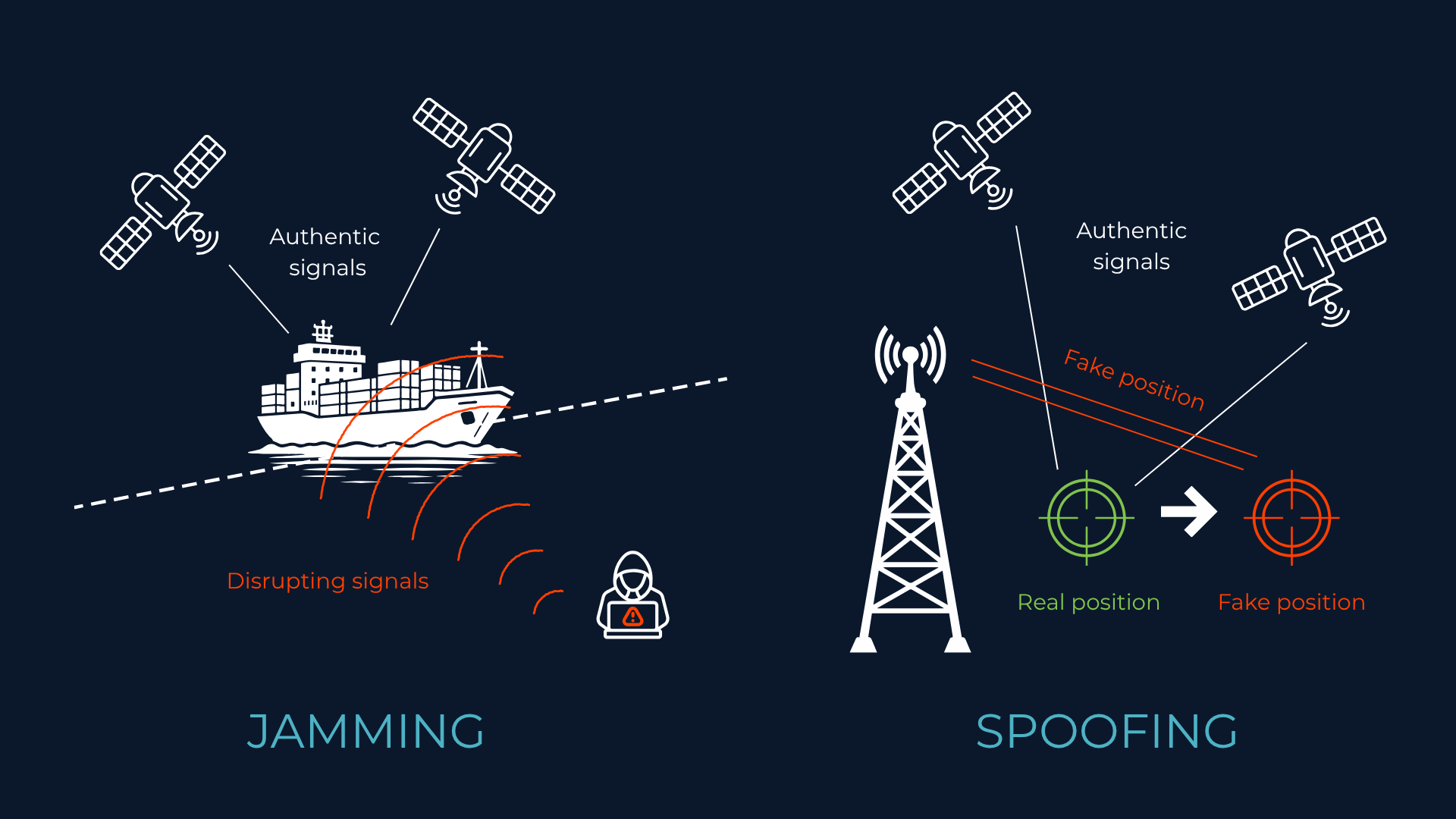
This dependence introduces new forms of vulnerability. GNSS jamming can disrupt satellite signals, forcing vessels into degraded navigation modes or manual fallback systems. Even more insidious is GNSS spoofing whereby someone transmits counterfeit signals to deceive a ship’s onboard navigation system, misleading vessels into believing they are somewhere else entirely. More than interfering with navigation, it corrupts trust in navigation itself, increasing collision risk in congested waterways and destabilising automated systems that depend on continuous positional accuracy. The same logic extends to AIS spoofing, which involves intentionally transmitting falsified AIS messages such as fake GPS coordinates or vessel identity, or duplicating transmission to simulate “ghost” ships. In the case of the Straight of Hormuz Crisis, during the first days of the war alone, GPS #jamming and #spoofing disrupted the navigation systems of more than 1,100 commercial ships in UAE, Qatari, Omani and Iranian waters. This was in addition to the application of traditional Iranian naval pressure (i.e. drone attacks, vessel seizures, asymmetric tactics). The economic consequences of such chokepoint disruptions are real and immense with an estimated loss of 14.1 USD billion due to delays, rerouting, insurance premiums, and trade disruptions.
From labs to oceans: how AI and dual-use startups are rewiring maritime security
As maritime security is becoming increasingly digital, data-driven, and hybrid in nature, the ecosystem responding to them is also changing. Where states once stood as the primary actors, a broader network of startups, AI developers, commercial satellite operators, and #dual-use technology providers is emerging as part of the maritime security architecture. Technologies that might have originally been designed for purely civilian purposes are now being integrated into wider security and resilience frameworks. Artificial intelligence in particular is rapidly reshaping maritime #SituationalAwareness as these systems can process large volumes of satellite imagery, detect suspicious vessel behaviour, identify anomalies in Automatic Identification System (AIS) transmissions, monitor subsea infrastructure, and anticipate congestion or operational risks across critical maritime corridors.

One such leading maritime tech company operating at the crux of commercial shipping and defence applications is Orca AI. They see the crisis in the Strait of Hormuz as the most acute manifestation of a broader pattern of escalating disruption across key shipping corridors, where GPS spoofing, AIS dark activity, and degraded operational pictures are increasingly undermining maritime domain awareness for both commercial and defence actors. Their response to the challenge has been to create their very own AI and computer vision technology. Having already been installed on more than 1200 commercial vessels navigating the world’s most congested waters, for defence use cases, the programme focuses on persistent monitoring, threat detection, and situational awareness in environments where traditional sensors cannot be relied upon. As Dor Raviv, Co-Founder of Orca AI notes:
“The underlying capability is the same: seeing what’s physically there, independently of GPS or AIS. Dual-use foundation is increasingly what resilient maritime operations look like, across sectors and across the full spectrum of complexity that today’s environment demands.”
Alongside this, autonomy-focused systems are making a case for themselves. As Pieter-Jan Note, CEO of MAHI notes:
“The conversation around maritime autonomy has shifted. It is no longer a question of whether autonomous systems belong at sea, but how quickly they can be made operationally ready and how well they hold up when conditions change. Fleets today need systems that adapt as requirements and missions change. Resilience, in our view, cannot be an afterthought.”
Their approach combines onboard sensor fusion with edge-based decision-making, allowing vessels to operate safely and independently even when communications are unreliable or the environment turns hostile. Moreover, the system gives mission control to the operator by allowing mission behaviours to be adjusted in the field, without waiting on engineering teams or external vendors.
Financing and scaling the next phase of maritime security resilience:
Maritime security sits at the intersection of physical protection, cyber resilience, and dual-use technological innovation. In response, Europe is building an innovation and #funding architecture designed to mobilise industry. This is being pursued through instruments such as the European Defence Fund (EDF), EU Defence Innovation Scheme (EUDIS), Horizon Europe, BlueInvest, NATO Defence Innovation Accelerator for the North Atlantic (DIANA), linking dual-use innovation more directly to both economic competitiveness and security objectives.
About the guest contributor:
Dor Raviv is the CTO and Co-Founder at Orca AI, a maritime tech startup, empowering shipping companies to enhance their operational safety, efficiency, and sustainability through a single AI and computer-vision-based operations platform.
Pieter-Jan Note is the Co-Founder & CEO of MAHI, a dual-use company offering comprehensive situational awareness, remote operation, and autonomous navigation capabilities for surface vessels. The company delivers state-of-the-art, easy-to-integrate modules for collision avoidance, communication, and autonomy to USV developers and maritime operators – increasing operational capabilities while reducing cost and time-to-market.
On the radar:
- 2 – 3 June: European Aerospace & Defence Summit (Düsseldorf, Germany)
- 3 June: European Network of Defence-related Regions (ENDR) Conference (Gijón, Spain)
- 9 – 10 June: TechNet International (Brussels, Belgium)
- 10 – 11 June: Supply, Security & Defence Expo 2026 (Tallinn, Estonia)
- 15 – 16 June: European Cybersecurity Forum (Katowice, Poland
- 15 – 19 June: Eurosatory (Paris, France)
- 23 – 24 June: European Defence & Security Summit 2026 (Brussels, Belgium)
- 30 June – 1 July: 6th Annual European Space Forum (Brussels, Belgium)
- 30 June – 1 July: Arctic Security – Multi-Domain Forum (Stockholm, Sweden)

Sophia Nee, Communications Consultant