Welcome to September’s TechAways!
Dear reader,
Europe2031 is intentionally dramatic. But we would ignore it at our peril.
Its central warning is that Europe may wake up one day with very little leverage left: dependent on foreign frontier models, foreign compute, foreign infrastructure, and holding only a handful of strategic cards it can no longer afford to play.
The risk is real. Yet many of the proposed solutions still feel too cautious for the scale of the challenge.
Tell a more positive story about AI? Fine. But Europe has spent years talking about adoption, productivity and growth. The narrative has not changed the trajectory.
Invest in robotics and physical AI? Absolutely. But let’s also acknowledge what that means: deploying technologies that will automate tasks currently performed by people. In a democracy, that is not a cheerful innovation agenda.
Build coalitions of middle powers? Necessary. But governments change, political priorities shift, and partnerships are rarely permanent. If anything, recent geopolitical developments are further proof than no two countries are forever friends.
So, what would a more courageous response look like?
It would begin with honesty.
Europe cannot preserve every existing job, every incumbent business model and every national preference while also competing successfully in the next technological era.
Something has to give.
The New Societal Deal should be this: Europe embraces AI adoption, automation, robotics and industrial transformation at speed in exchange for a social contract that protects people rather than tasks.
That means portable benefits. Lifelong learning accounts with real funding behind them. Rapid retraining tied to actual labour market demand. Faster permitting for data centres and energy infrastructure. Public procurement that gives innovative firms a genuine pathway to scale. Capital markets that allow companies stay and grow in Europe. A revamped approach to education and work that promotes and rewards risk-taking.
The choice Europe faces is not between disruption and stability.
The disruption is coming regardless.
The real choice is between managed adaptation and unmanaged decline.
Europe will need to move faster than feels comfortable, because standing still is no longer the safe option. In return, governments must ensure that the costs of transition are shared fairly and that citizens are not left to bear them alone.
That is the foundation of a New Societal Deal for the AI age.
Sabina Maria Ciofu (she/her), techUK
About this week’s guest editor, Sabina Maria Ciofu
I’m a Romanian Belgian, living in Brussels and working where technology, geopolitics and trade collide. As International Policy & Strategy Lead at techUK, I spend my time helping the UK tech sector navigate AI, digital regulation, economic security and the increasingly fragmented global technology landscape. Before techUK, I spent nearly a decade advising a Member of the European Parliament on technology and trade policy. Somewhere along the way I also developed a habit of building communities, connecting people and organising far too many events. When I’m not discussing AI governance or transatlantic tech relations, you’ll find me on a plane, on a tennis court or training for my next marathon.
Love reading out-of-the-Brussels-bubble tech news? Share it with your friends and colleagues. They can subscribe here.
Ideas? Suggestions? Comments? Send them our way!
#TechAways is brought to you by SEC Newgate EU’s one and only #tech team featuring Shauna Downey , Giuseppe Campa , & Josef Cutajar.
Policy Pixels
On September 9, the European Commission published its eagerly awaited proposal for the Public Procurement Act, which aims to overhaul the rules for how public authorities across the EU make purchases. Public procurement currently drives around 15% of EU GDP, and with the Commission’s new proposal, public buyers will be obliged not only to consider price but also sustainability, social and resilience-related criteria, while giving priority to EU products in certain strategic sectors. This “Made in Europe” requirement potentially provides a much-needed boost to domestic industries but also risks disincentivising foreign investment and stoking tensions with EU trade partners. Expect this one to be closely fought over.
Complementing the above, the Commission – finally – introduced the European Innovation Act on the same day, after it was previously twice-delayed earlier this year. This initiative will seek to harmonise the rulebook for how public authorities procure early-stage technologies, establishing a more supportive environment for innovative European companies.
[US] Lawmakers blast AI companies after researcher warns of human extinction by 2030 [The Guardian]
Jacob Coxon, a 27 year old researcher who spent three years on pretraining at OpenAI and then Anthropic, resigned publicly on X. Neither company is acting responsibly, he wrote, accusing both of racing towards self improving superintelligence. The thread drew close to 76 million views. What made it land differently from the usual doom commentary was the corroboration: at least two Anthropic colleagues backed him, including alignment lead Evan Hubinger, who put his personal odds of catastrophe above 10%.
Congress has largely ignored existential risk arguments for three years, mainly because they came from academics rather than the people building the models. That changed within a day. Ted Cruz and Bernie Sanders, not natural allies, both called for guardrails. Anthropic said it has always been transparent about the risks and called for industry coordination on release pace. OpenAI did not comment. President Trump said he was not worried, arguing the priority is staying ahead of China.
Study Suggests AI-Generated Drug Could Slow Aging [Gizmodo]
A new study published in Nature Biotechnology suggests that an AI-generated drug called “Rentosertib” (also known in research as (INS018_055) may help slow biological aging. Developed by Insilico Medicine with the aim both treat both chronic lung disease and extend lifespan, the drug was tested over a 12-week trial involving 42 participants. Researchers observed that patients taking rentosertib experienced a reduction in their biological age across six different AI-driven aging clocks, while those receiving a placebo saw their biological age remain unchanged or increase.

Despite these initial results, the broader medical community remains cautious about the actual utility of aging clocks, which measure markers like DNA changes and blood proteins. Critics point out that there is currently no universally accepted standard for biological age, and attempting to artificially lower these clock measurements could potentially interfere with the body’s natural repair mechanisms. Ultimately, while Rentosertib represents an intriguing step forward for AI drug discovery, it remains far from market availability and faces extensive clinical testing and regulatory hurdles.
A robot ran 100 metres in 8.64 seconds. Usain Bolt’s record is 9.58. [Interesting Engineering]
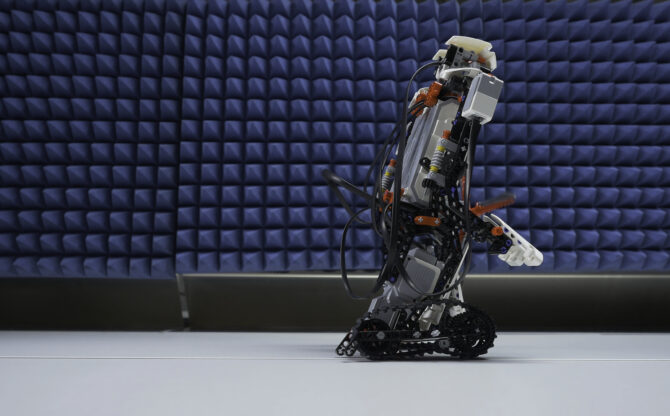
At the second World Humanoid Robot Games in Beijing, which ran from 22 to 26 August, a machine called Tiangong Ultra won the 100-metre final in 8.64 seconds. It broke the games record three times in five days, going from 9.39 to 8.86 to 8.64. The comparison with Bolt is not really fair, since the surfaces and rules differ, but the trajectory is the point: the same event was won last year in 21.50 seconds.
In case you haven’t had enough:
An AI found a WeChat flaw, then built a worm that spreads through missed calls [Quartz]
Saturn has grown a ten-sided storm at its south pole and nobody expected it [EarthSky]
Pop-tech pick
The AI Doc: Or How I Became an Apocaloptimist (2026) lands on Netflix on 15 September, which is about as well-timed as a pop-tech pick gets.
Quick synopsis
Director Daniel Roher, who won an Oscar for Navalny, is about to become a father. That is the whole framing device. He wants to understand what kind of world his child is inheriting, so he goes and asks the people building it. Sam Altman, Dario and Daniela Amodei, Yoshua Bengio, Timnit Gebru, Emily Bender, Yuval Noah Harari. Both the boosters and the critics, in the same film.
Might be worth a watch
Most AI documentaries pick a side and then go looking for interviews that confirm it. This one seems in the discomfort of not knowing, which is where most people actually are. The title is Roher’s own coinage for that position: expecting the worst, hoping for the best, unable to commit fully to either. It premiered at Sundance in January, ran in cinemas in March, and now reaches a much bigger audience just as the questions it raises stop feeling hypothetical.
Tim Edgar, Senior Adviser

Alí El Majjaoui, Communications Consultant

Shauna Downey, Media & Communications Trainee

Giuseppe Campa, Public Affairs Consultant