Defence has become everyone’s business again

For decades, Europe’s security architecture was built on the comfortable assumption that defence could take a backseat. Following the end of the Cold War, governments across the continent reduced #DefenceSpending, streamlined #MilitaryCapabilities, and redirected resources towards social welfare programmes. It was a rational response to the geopolitical realities of the time. Yet the #PeaceDividend came with an invisible cost: capabilities eroded, supply chains weakened, and defence innovation investment slowed.
Today, the bill has arrived. As Europe navigates a deteriorating security environment, defence is no longer a niche sector confined to ministries and military headquarters.
The good news? Europe possesses world-class universities, highly skilled engineers, deep scientific expertise, and a growing ecosystem of innovative defence and dual-use startups. Indeed, the industry is very dynamic and is reversing the #InnovationPipeline. Whereas in the past defence generated technologies that later entered civilian life (think GPS, the internet), today military organisations are adopting technologies first developed in commercial markets (e.g. #AI, #drones).
If this is all true, one question begs an answer: why does so much promising innovation fail to reach operational deployment?
Turning prototype into capability: Europe’s missing link
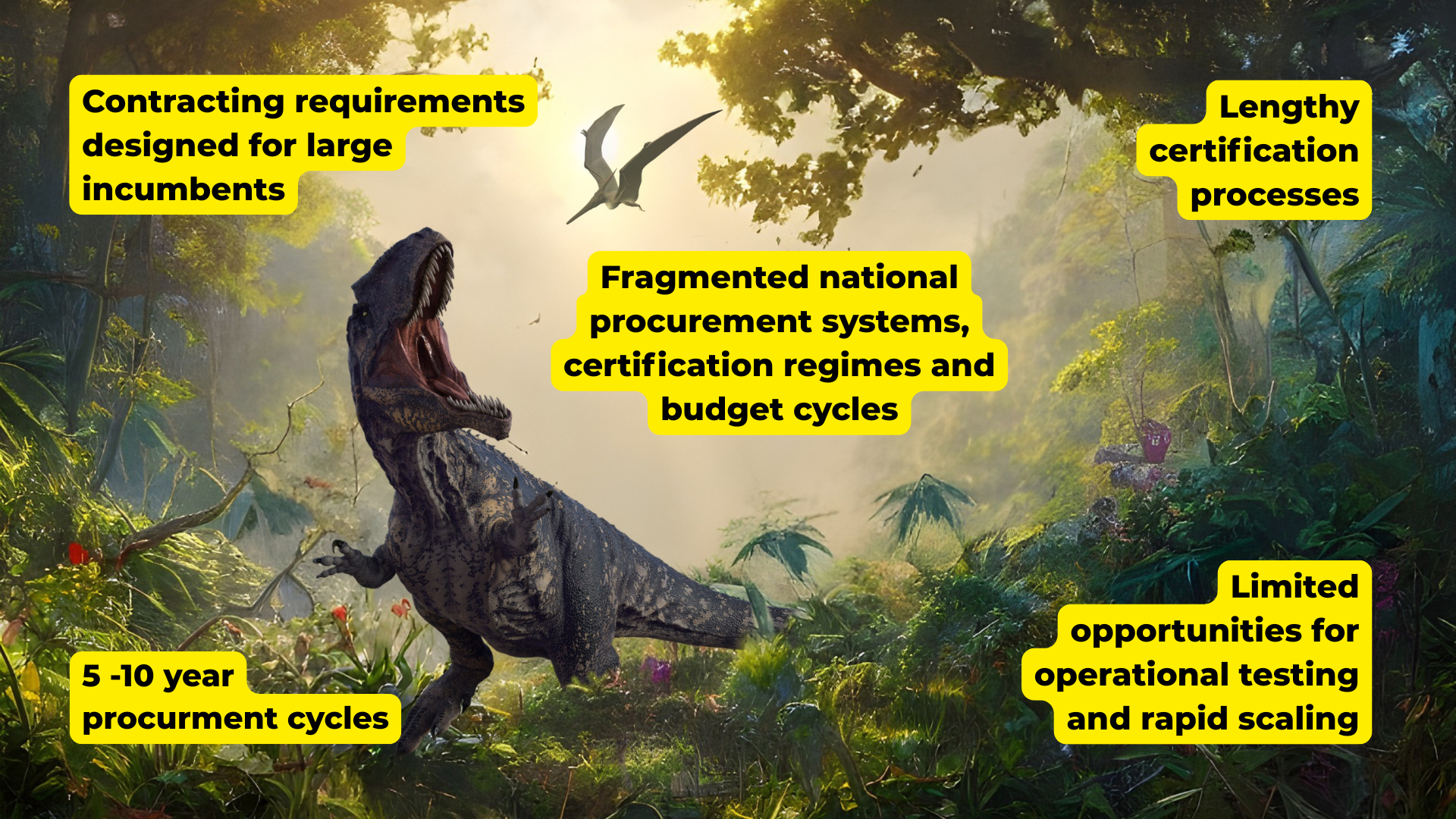
In many cases, transformative technologies already exist. What is missing is a fast, scalable, and predictable pathway to military use.
When Procurement Becomes the Battlefield. Across Europe, defence procurement systems were largely designed for a different era dominated by large established prime contractors operating on long development timelines. For innovative startups and SMEs, the reality can be daunting: procurement cycles stretching 5-10 years, contracting requirements designed for large incumbents, lengthy certification processes, and limited opportunities for operational testing and rapid scaling. As a result, many promising technologies encounter friction long before they encounter customers.
The real issue lies not in technological readiness, but in institutional readiness. Instead of chasing a new weapons system, perhaps the most consequential innovation Europe needs today is a new way of buying technology.
The Hidden Cost of Fragmentation. Compounding the challenge is Europe’s fragmented defence landscape. Despite increasing discussions around European defence integration, innovators still face a patchwork of #NationalProcurement systems, certification regimes and budget cycles. A company that successfully enters one market often finds itself starting from scratch in another. For example, a contract in France does not guarantee access to Germany. A certification in Sweden does not automatically unlock opportunities in Poland. Every national border introduces new administrative, regulatory and commercial hurdles. For startups operating with limited resources, this fragmentation is a significant barrier to scaling.
Without predictable growth opportunities, investors remain cautious. #VentureCapital struggles to accommodate long procurement timelines and uncertain market access. The result? A self-reinforcing cycle in which fragmentation discourages investment, and limited investment slows growth.
Learning from Europe’s success stories
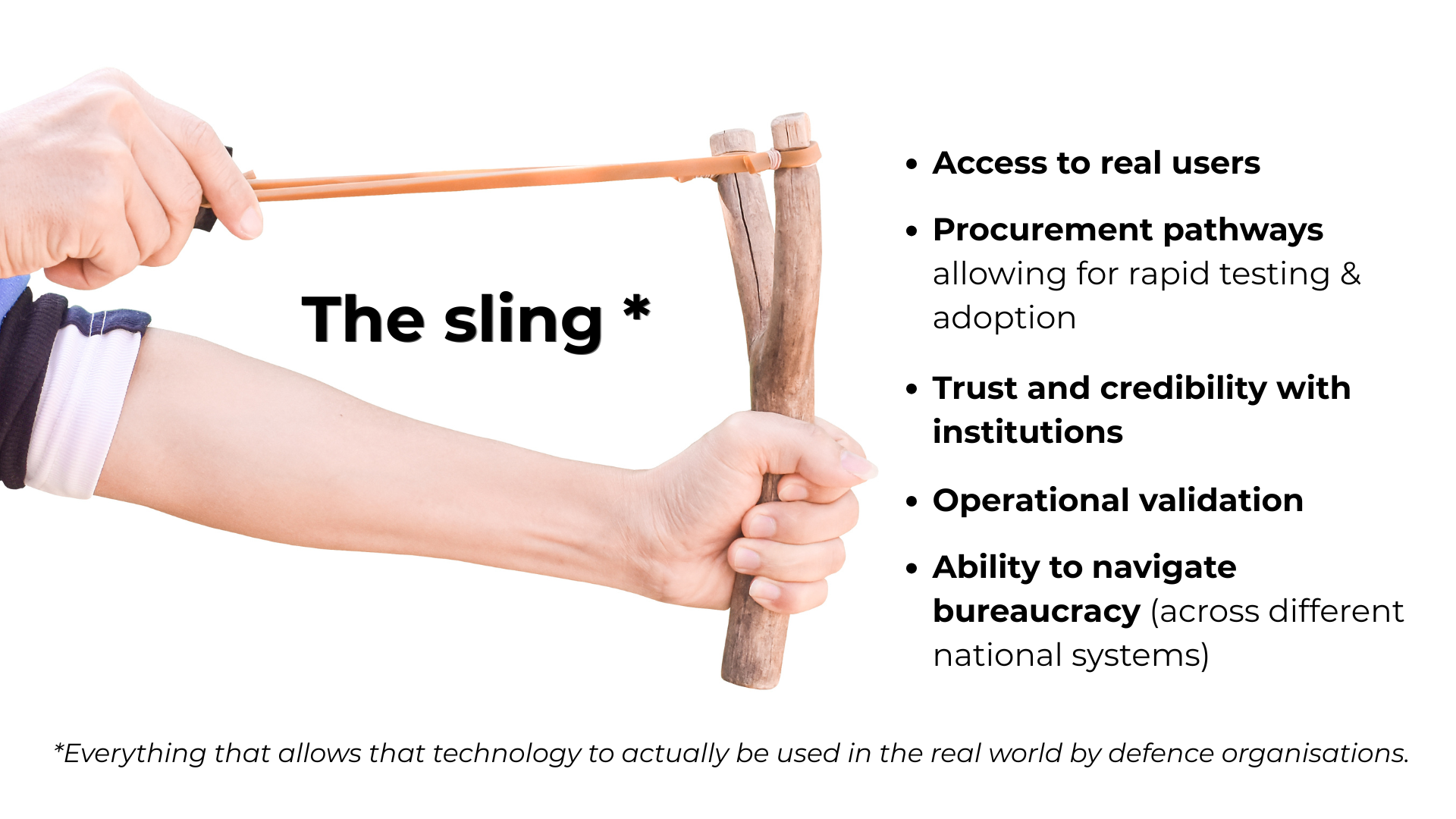
Despite these structural challenges facing Europe’s defence innovators, several companies have demonstrated that success is possible.
What are they doing differently? During an event organised by The French Tech Brussels and @BNP Paribas, Agoria BSDI‘s Antoon Boeykens offered a useful reinterpretation of the David and Goliath legend. Often understood as a simple tale of an underdog defeating a stronger opponent, the lesson is actually more nuanced. David did not win by becoming stronger than Goliath. He won by changing the rules of engagement. Europe’s most successful defence innovators have followed a similar path.
Companies such as Helsing and Tekever did not succeed by building better technology or outspending larger competitors. They succeeded because they found ways to make institutions trust, adopt, and scale that technology. Their competitive advantage lay not only in the quality of their “stone”, but in the effectiveness of their “sling”.
This is a lesson increasingly echoed by startups like DRV Solutions. Their advice to other founders comes down to three points:
“First, be committed: defence is a trust business, so show up, be visible, and if you really want to enter the market, show it by being persistent. Second, build your network: with a limited number of real end customers, no one succeeds alone, and partnerships are essential even if it feels scary. Third, be patient: there is no overnight success, and persistence is what ultimately pays off.”
One European security startup, Nemesis’ Babette de Decker, puts it more bluntly:
“The biggest barrier hasn’t been the technology. It’s trust. In regulated sectors, a security startup must prove three things at once: that its product works without becoming a second attack surface, that the company will still be around to support it in three years, and that it delivers measurable gains over incumbents already embedded in operations. Sovereignty alone is not a buying trigger, and adoption is won through proof (i.e. customer references), not positioning.”
For Europe’s defence startups, the lesson is clear: As Boeykens argued, success in defence requires speaking two languages fluently: engineering and innovation on the one hand, and government and institutional trust on the other. The most successful innovators engage end users early, build credibility through operational demonstrations, and understand how procurement decisions are made in practice, not just on paper.
Looking ahead
Europe’s defence debate often focuses on breakthrough technologies, from AI-enabled systems to autonomous platforms. Yet the continent’s most pressing challenge may be far less glamorous: building the institutional mechanisms that allow innovation to move rapidly from prototype to deployment.
Procurement reform, greater market integration and stronger pathways for startups and SMEs are not administrative details. They are strategic enablers.
If there is one thing Europe does not suffer from, it is a shortage of ideas, talent or ambition. It has no shortage of Davids. The question is whether it can build enough slings to help them succeed.
About the guest contributor:
Babette de Decker is the co-Founder of start-up Nemesis Breach and Attack Simulation whose mission is to empower organisations to identify vulnerabilities, optimise security measures, and build resilience against modern cyber threats through innovative, offensive cybersecurity solutions. Their vision is to become the global leader in proactive cybersecurity, driving the evolution of digital defence strategies and enabling businesses to thrive in a safer, more secure digital world. Find our more on their website.
DRV Solutions develops sovereign electric motor propulsion systems for unmanned vehicles (UxVs) designed to reduce reliance on vulnerable Chinese supply chains for critical components like rare-earth magnets and copper conductors. Its platform aims to enable scalable, Europe-based production of defence-grade UxV propulsion so programmes can be rapidly sustained and replenished in modern conflicts.
On the radar:
- 30 June: 6th Annual European Space Forum (Brussel, Belgium)
- 30 June – 1 July: Arctic Security – Multi-domain forum (Stockholm, Sweden)
- 30 July – 1 July: The 5th Annual European Space Forum (Brussels, Belgium)
- 2 July: European Space Security & Defence Forum (Brussels, Belgium)
- 7 July: European Defence Agency (EDA): Defence industry workshop (Brussels, Belgium & Hybrid)

Sophia Nee, Communications Consultant