At this year’s European Sustainable Energy Week – held at the Charlemagne building, in the shadow of the Berlaymont- Europe’s energy debate has returned to the main stage.
By early morning, the main conference room was already packed with officials, industry stakeholders and national representatives; a sign of how critical the discussions on Europe’s energy sector today are.
Energy and Housing Commissioner, Dan Jørgensen opened the event by going straight to the point; Europe is still dealing with the fallout from the energy crisis, and the risk of renewed price shocks remains real. He began with a rhetorical question: “will we slide towards crisis, or will we move together towards opportunity?”
He pointed to the energy crisis as a defining pressure point for Europe, but also as a catalyst for change. Among the European Commission’s initiatives he highlighted, were the Affordable Energy Action Plan, a core element of the Clean Industrial Deal, and AccelerateEU, designed to respond to high energy costs, geopolitical instability and continued reliance on imported fossil fuels.
He also stressed the importance of bringing citizens closer to the transition. Energy labelling, he argued, is already making a measurable difference. Most European citizens are influenced by labels when purchasing a device, he explained.
He closed his remarks with a quotation from George Bernard Shaw, popularised by Robert F Kennedy: “Some men see things as they are and ask why. Others dream things that never were and ask why not.” It was deliberate, as Ireland’s Minister for Energy and Climate, Darragh O’Brien, followed him on the stage immediately afterwards.
O’Brien’s week in Brussels comes ahead of Ireland taking over the rotating presidency of the Council of the EU on July 1, which will place “the negotiations on grids, electrification and data centres” at the centre, as he emphasised. In this context, the key EU dossiers for the Irish Presidency include the European Grids Package, the Energy Taxation and Network Charges file, and the Energy Security Framework. He also called for faster deployment of renewables, stronger investment in grids and large-scale retrofitting.
However, Minister O’Brien also highlighted the need for a careful balance between urgency and long-term planning. “We must respond to the immediate pressures on households, businesses, and industry, while maintaining a very strong focus on long term transformation”, he said, before setting out Ireland’s priorities. These include delivering an integrated, secure, affordable and sustainable EU energy system, advancing climate neutrality by 2050, strengthening European sovereignty and resilience, and improving resource efficiency.
MEP Elena Donazzan took a more assertive tone, warning that Europe can no longer afford delays. “Europe must act without delay and with a long-term strategy”. She added “we can no longer rely on short-term solutions. Climate change is already happening. We must pursue decarbonisation with determination”.
Determination, for her is “investing in renewables, but also recognising all technologies, including nuclear, hydrogen, geothermal, carbon capture”. She went further, arguing that nuclear power is essential to phasing out fossil fuels, citing Italy as an example where “energy prices are about double those in France, largely due to differences in energy mix”. If that was not clear enough, she summed up her position: “renewables and nuclear are not alternatives, they are complementary”.
Lessons from the past, pressure from the present
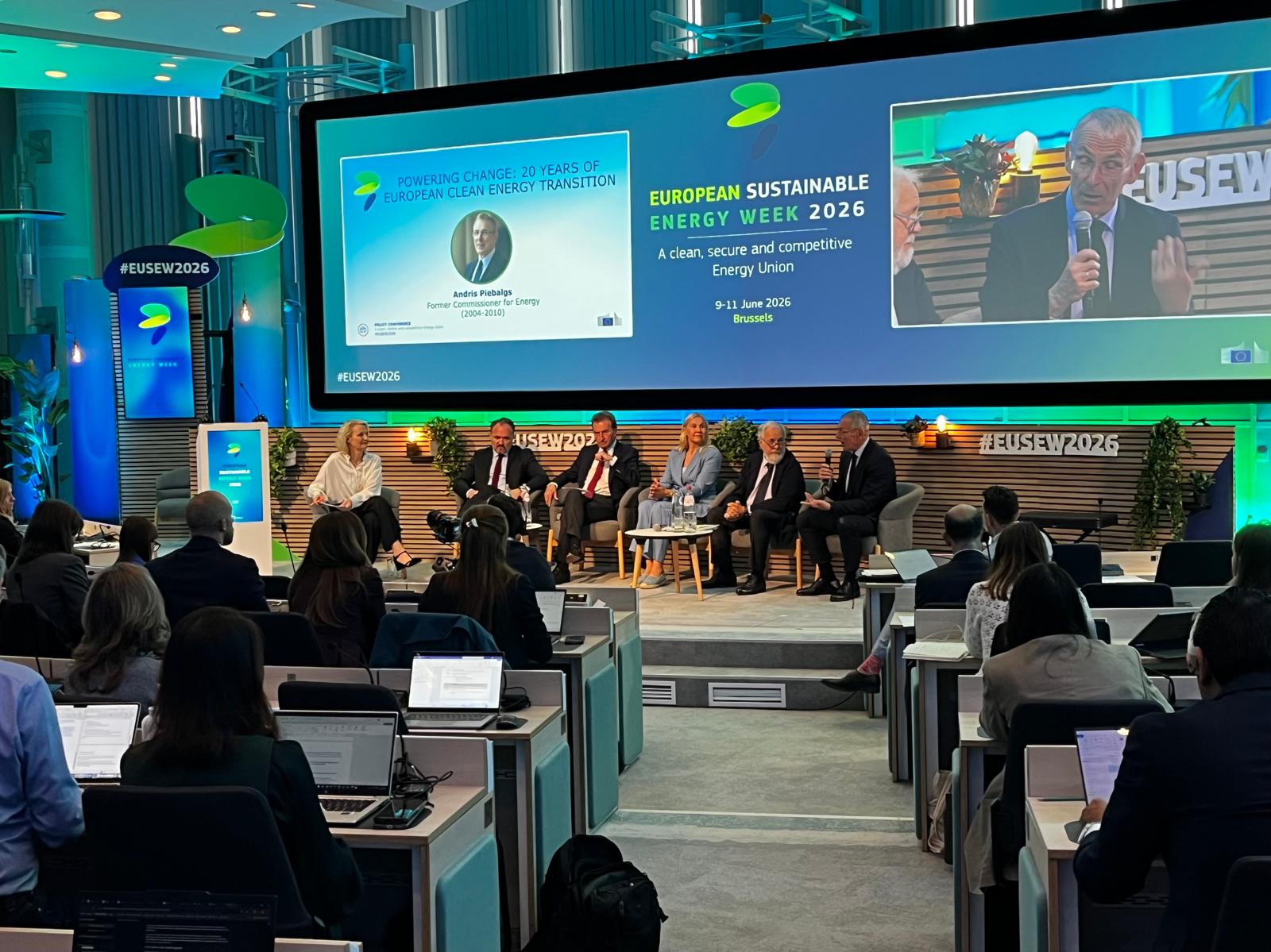
The week also featured a major panel marking twenty years of the European clean energy transition, bringing together Dan Jørgensen with former Commissioners who previously had his job: Andris Piebalgs, Günther Oettinger, Miguel Arias Cañete and Kadri Simson.
The discussion turned into a reflection on how dramatically Europe’s energy landscape has shifted. Jørgensen pointed to the impact of Russia’s invasion of Ukraine and the ongoing geopolitical tensions affecting global energy markets, noting rising costs and long-term structural vulnerability. He added that “we [Europe] spent €140 billion more on our energy since the crisis started” and concluded “This is not a good situation”.
Kadri, who was in charge of energy policy during the second Von der Leyen Commission (2019–2024), reflected on the political climate that shaped the European Green Deal, recalling that “when I started, there was strong pressure from movements saying older generations don’t care about climate as much as they should. Based on that, we made very ambitious proposals”.
Miguel Arias Cañete looked back to the Paris Agreement, describing efforts to build a high ambition coalition across major economies, including Brazil and the United States during the Obama’s presidency, before the US later withdrew on two occasions under both Trump administrations.
Günther Oettinger, who held the energy portfolio during the second Barroso Commission term (2010–2014), said that “at that time, dependence on Russian gas was not expected to become such a major issue. But we underestimated risks. Today, we need to strengthen independence”.
Andris Piebalgs returned to a longer historical view, noting that nuclear energy has always been part of Europe’s energy system, while stressing that the current priority is investment, security and integration across the wider energy mix.
The discussions continued at length over the following two days, bringing together more commissioners, policymakers and industry representatives. It ultimately marked one of the timeliest editions of an event that has been shaping and reflecting the energy debate in Europe for the past 20 years.
Alí El Majjaoui, Communications Consultant