At the World Economic Forum in Davos, Ursula von der Leyen announced the European Commission’s intention to propose EU Inc: a new pan-European company structure designed to let businesses operate seamlessly across all EU member states under a single, standardised legal framework.
Around the same time, OVHcloud CEO Octave Klaba delivered a clear message to investors. The company no longer wants to be framed primarily as a French champion, but as a fully-fledged European cloud provider.
Together, these two developments point to the same conclusion: if Europe is serious about digital sovereignty, structural change is unavoidable.
Reality is that several EU economic sectors – key to the digital economy – continue to struggle with scale. Cloud providers, in particular, have become essential to public services, industrial data, AI deployment, cybersecurity, and critical telecommunications infrastructure. But still – Europe’s cloud market remains fragmented along national lines. While public policy has largely focused on funding European digital infrastructure, non-European hyperscalers still dominate the market.
For instance, OVHcloud operates 46 data centres, serves more than 1.6 million customers, and reported €275 million in revenue in the first quarter of 2026, with 6% organic growth. Still, nearly half of that revenue is generated in France – a concentration Klaba openly describes as a vulnerability. As he put it bluntly: “as soon as France coughs, we cough too.” A cloud provider capable of serving the needs of the EU-wide market cannot remain hostage to national economic cycles.
This is where the Commission’s EU Inc proposal begins to make industrial sense. The idea is to create a so-called “28th regime”: a corporate framework that sits above national systems and enables companies to scale across Europe more easily. It also echoes long-running debates, notably those sparked by the Draghi Report, on how to strengthen EU competitiveness and secure Europe’s digital future.
The real challenge now lies in turning EU Inc into law. Corporate structures, taxation, and company law remain deeply political. Member states are inclined to nurture national champions, attract companies, and retain fiscal benefits. A genuinely European corporate framework would inevitably disrupt that balance.
Making EU Inc work will require political courage – and a clear focus on the bigger prize rather than national pride. If Europe wants digital champions that can scale globally, member states may have to accept deeper integration, fewer national trophies, and shared gains. That, ultimately, may be the real price of digital sovereignty.
About this week’s guest editor, Anastasia Sendrea.
Anastasia is a tech generalist fascinated by the digitalisation of everyday life. She got her first PC at the age of 12 – and proudly remembers when ICQ, mIRC, Winamp, and MySpace were novelties in Europe.
During her studies, she became increasingly interested in how societies and governments respond to technological innovation – and to what end we choose to regulate it. In her day-to-day, each week brings a new story that raises the same question: how can we shape technology in ways that serve our collective good?
By day, Anastasia works with industry associations in the telecommunications sector, drawing on her curiosity about the societal impact of tech. By night, she does her best to keep up with her fierce, free-spirited six-year-old.
Love reading out-of-the-Brussels-bubble tech news? Share it with your friends and colleagues. They can subscribe here. Ideas? Suggestions? Comments? Send them our way!
#TechAways is brought to you by SEC Newgate EU’s one and only #tech team featuring Sarah Harry, Ali El Majjaoui, Camilla Frison, Dániel Kovács, and Giuseppe Campa.
Why open-source ecosystems may decide the future of AI power 🧠 [Tony Blair Institute for Global Change]
A new paper from the Tony Blair Institute for Global Change argues that AI power isn’t just about who builds the biggest models, but about what governments and societies can practically do with them. For most countries, influence will depend on how AI is applied, adapted and governed. Using Ukraine as an example, the paper shows how open-source tools, shared data and public-private cooperation can strengthen EU-wide resilience, even in crisis. How? By making systems more adaptable across borders and less dependent on single vendors. But openness is not friction-free. A separate report from Centre on Regulation in Europe by Zach Meyers warns that openness remains a technical and governance challenge that neither the Commission, gatekeepers nor platforms can solve alone. The real test now is how transparency, accountability and oversight are built into these open systems as they become more widely available. 
Au revoir, Zoom! France’s turn to digital patriotism 🇫🇷 [Euronews]
Digital developers in France – your time has come! EU-US relations have been frosty lately, to put it mildly, and this has raised questions in Europe on the extent of the continent’s reliance on our transatlantic allies across a variety of sectors – with tech being no exception. Accordingly, the French government announced that by 2027 videoconferencing within all its departments will move to the French-made Visio, ditching the American platforms Zoom and Microsoft Teams currently in use. But it does not stop there – beyond intra-bureaucracy video-calling, the country is planning a wider-reaching plan for digital sovereignty, which envisions an entire ecosystem of locally developed tools that would ultimately also replace other US services such as Gmail or Slack as well.
The EU sets out to cure our TikTok addiction📱[The Guardian]
Have you ever found yourself endlessly browsing through TikTok for hours at a time? The app has long held a reputation for being the most addictive social media platform – and the EU now wants to do something about it. In the preliminary ruling of an investigation, the European Commission indicated that the platform has violated the Digital Services Act (DSA) due to its ‘addictive design’, which turns the brains of its users into ‘autopilot mode’ and can result in compulsive behaviour and a reduction in the users’ self-control.
Naturally, TikTok was quick to dispute the commission’s claims, saying that they are “a categorically false and entirely meritless” assessment of the platform. Nevertheless, if the investigation ultimately concludes that the app has in fact breached the DSA, it could face fines of up to 6% of the company’s annual turnover and be forced to implement redesigns – possibly freeing up countless hours of mindless scrolling amongst young Europeans.

Feeling nostalgic? The OG cool kids’ business phone is back, just not as a phone 📟🔐 [Euronews]
Remember the BlackBerry, the 2010s status symbol with the clicky keyboard and secure emails on the move? It ruled the corporate world until Apple’s iPhone and Google’s Android reshaped everything with touchscreens and app stores, pushing BlackBerry handsets into a slow decline. But the company never vanished; it just reinvented itself. Speaking at the World Government Summit, CEO John Giamatteo explained that BlackBerry is now focused on cybersecurity and the Internet of Things. Its QNX operating system powers key functions in connected and autonomous vehicles, while its encryption services protect communications for governments, banks and defence organisations. And despite the rush toward AI, BlackBerry is careful about using it in mission-critical systems where mistakes could be costly. The famous keyboard may be only a memory now, but the obsession with security and trust is very much alive.

The war on tech takes a new shape 💻🛡️ [Politico]
A growing cry is emerging from several European countries against social media platforms, as governments try to shield children from the horrors of endless scrolling. Denmark announced measures last autumn to ban social media for anyone under 15. France is heading towards similar action, while in Portugal, the government submitted draft legislation requiring anyone under 16 to get parental consent to log in.
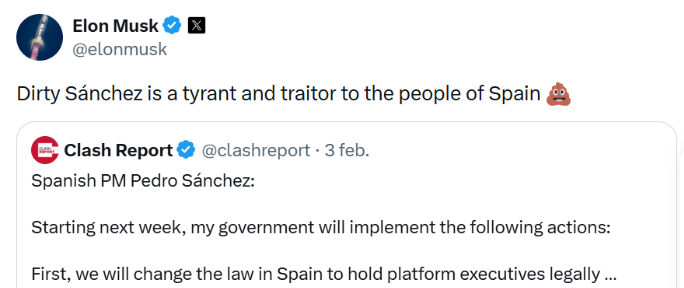
The latest to join the front is Spain. Prime Minister Pedro Sánchez recently unveiled a package of measures, including a social media ban for under-16s. Unsurprisingly, big tech companies were not pleased, waving the usual “freedom of speech” banners. Elon Musk, in a post on his platform, called Sánchez a “tyrant and traitor to the people of Spain” and “the true fascist totalitarian”. Maybe a bit dramatic, Elon?
This represents a new battle in the long-standing conflict between European Union regulation and big tech companies, which had hoped that under Trump new era, Europe would soften its stance. Instead, it seems Europe is moving in a very different direction.
Plus, in case you’re still curious:
Policy Pixels
Children protection online Child safety online is becoming a defining tech-policy theme in Brussels. On 10 February, the European Commission unveiled its EU Action Plan on Cyberbullying, setting out EU-level best practices for assisting victims, the rollout of an accessible online safety app across all member states, and a strong push on prevention, awareness and education. At national level, political pressure is also building, with France and Spain debating social media bans for minors. In parallel, enforcement is tightening: the Commission is pursuing an investigation on TikTok under the Digital Services Act over addictive design features linked to minors’ protection — a case whose logic could extend to any digital platform built around similar engagement mechanics.
Coming up: Industrial Accelerator Act Next to watch is the Industrial Accelerator Act, expected on 25 February. While not a digital policy file, it could have meaningful implications for the tech sector by introducing the EU’s first concrete definition of European preference, anchoring the idea that European public money should prioritise European production in strategic sectors. Once on the books, this concept could spill over into the upcoming reform of EU public-procurement rules, with clear downstream effects for companies competing for publicly funded projects.
Pop-Tech Pick
If you’re trying to keep up with AI, platforms and the latest tech shifts without wading through jargon, Hard Fork is a solid place to start.
Quick synopsis: Hard Fork is a weekly podcast from The New York Times where journalists Kevin Roose and Casey Newton unpack the future of tech – and explain why it already feels like the present.
What’s so special about it? It helps you stay up to date with the fast-moving tech debates – making it accessible without dumbing it down. Popular topics like AI power, platforms and digital culture are broken into clear, relatable conversations you can actually follow – and enjoy – without needing a technical background.

Alí El Majjaoui, Communications Consultant

Giuseppe Campa, Public Affairs Consultant

Camilla Frison, Media Relations Consultant